Executive Coach: Getting Great Focus
Focusing on the right things involves completely different challenges

Thinking about writing this paper, three questions turned up for me that I want explore with you. Here are the questions:
- Focus as a day-to-day function of life can be relatively easy. But is it the right Focus? And how do we know?
- Personal truth and our life purpose are not as easy to keep in Focus, but vital for leaders and coaches. How do we find and maintain Focus on our deeper purpose?
- Why are some organisations taking the initiative to train leaders in Focus, Attention and Consciousness?
The Wrong Focus can be Destructive
Tom, the CEO of an ASX 100 company came to us in dire circumstances. Despite the best efforts of his stellar executive team and super competent Board, the company had slipped into serious loss of over $150m. Spending time with Tom and his team it became apparent they were all highly charged and focused on their own department. However, as a collective they were unfocused and uncoordinated. The result of focusing on the wrong thing (solely their own area) was now a disastrous and unsustainable financial loss for the company.
As developmental advisors, we concentrated on building the executive team’s collective focus. The team included Tom as CEO. Because this was a crisis, we got them to focus on their close-up target. Where do they want to be 2 years from now? (Yes, 2 years is not quick but realistic). We asked the team to imagine what this felt like: how well they’re leading; what they are doing and saying, who else is there, how the Board regards them, what new deals are coming up, how well they work as a team … all the time feeling fantastic.
Then the team set a single collective goal for the next 2 years. They made significant changes to the team. A few months later a major team member decided to leave (his true focus was elsewhere). The team set up ways to maintain their focus on their collective goal.
The outcome? They far exceeded their goal and turned around the company within 18 months. A brilliant team effort with clear focus.
Have you thought about Focus as a Landscape?
Like Tom’s executive team, we all have the whole landscape of life ahead of us, no matter what our age, responsibilities or how great or small our achievements. What we choose to focus on in this landscape will set our path and mindset for the future.
It is as though we are the Director of Photography on a film. What is the right focus that sets the scene – is it to be a close-up, a mid shot or a long shot? All serve different and significant purposes.
These three camera shots represent three levels of focus – close up is the next 18 months to 3 years; mid shot is the next 7 to 10 years; and the long shot is end of life. When I work with a client I generally start with the long shot because that is the ultimate destination. Once we know our destination we know where we’re going. The long shot clarifies where and how we want to end up, what matters, and who we want to become. Then we work backwards from there to the present time. It’s a moving experience.
By unfolding and knowing our destination, our life’s purpose emerges. It is our grounding and primary focus, unique and inspirational to each one of us. Once we glimpse what that uniqueness is, we keep it fresh and in focus.
How Focus Works in a Nutshell
Being clear about purpose is a vital element of focus. It is the Why of focus and its goal, task or target.Without purpose we run out of energy pretty quickly and the task can turn into drudgery. Having purpose is uplifting and generates conviction, a powerful driving force and attractor to assist momentum and progress.
Neither purpose nor conviction on its own are much use to anyone else. To share something of value we need to add contribution, the action and giving out that arises from our purpose and conviction. Contributing adds the glue that makes purpose and conviction stick.
Without Focus we become aimless or open to anxieties
Chris was owner of a start-up training company, keeping five training consultants busy. His goal was to run a brilliant national training company specializing in productivity. He imagined top quality courses and happy participants feeling confident, with fantastic techniques to help them achieve their best productivity at work.
Over time, Chris began to focus increasingly on the lack of funds and cash flow and what was not working. Eventually this became his sole focus. He was stuck on negative detail. His anxiety was sky high.
Chris was not seeing what was working and the forward steps taken. His purpose and uplifting goal was gone, inaccessible. He sweated over what to say to prospective clients, but his anxiety came through and he came across as desperate. Prospects backed away.
Other entrepreneurs encounter similar negative setbacks. Lack of cash flow is common initially. The one single element that makes the difference between going under and making it, is what we focus on. Being aware of what we focus on plays a big part. This requires ability for “meta attention” or paying attention to our attention.
So, As Coaches, What Do We Focus On?
When coaching Executives and Directors, we need to stay on our toes. We could take this to mean staying informed about economic, national and world affairs, especially knowing what is going on in the client’s industry. What we know, relevant to the clientis important for coaching.
Some coaches put more effort into their coaching technique. We can make sure we do all that is expected in terms of the best coaching techniques plus back it up with sound administrative systems. This is all good method and business procedure that ensures we seem proficient and skilled. Here, what we do (and the way we deliver it) is in focus.
There is a third area of coaching focus that is more immeasurable and has received the least attention. But that is changing. Companies as diverse as Joie de Vivre Hotels and Apple, have got it, applied it and love it, claiming greater focus, success and happiness within their organisation. The third area of coaching focus is coaching as a state of Being.
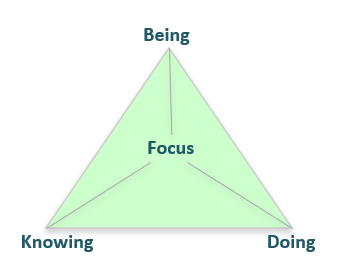
Knowing, Doing and Being are not personality types. They are preferred or habitual inner states that can be brought to awareness and through practice, chosen at will. Focus is central to each state - to Know, to Do and to Be.
As a coach, what is your primary focus – Knowing, Doing or Being?
You know the story; to reach master quality at each of the three levels of attention takes about ten years’ practice. We have really made it when we can access all three levels simultaneously. Think about that. It’s an integration of body, mind, spirit – thinking logic/recalling intellect; action-intelligence; fully present awareness/inner truth; and then integrating the three states with discernment and wisdom. That’s dancing in the light of consciousness.
Traps for Losing Focus
While focus is uplifting and can ignite energy, the other side of focus is elusive. We can slip off focus without realizing and expend much time and energy on peripherals that lead wild goose chases.
For instance, Andrea, a spirited coach, became anxious about an upcoming interaction with her client’s Board, fearing she had over-stepped the line responding to an aggressive director on behalf of her client.In the weeks leading up to the Board meeting, Andrea spent a lot of time thinking about the meeting. She felt she was highly focused. In fact, her focus had slipped from her client and the actual coaching circumstances to managing her own anxiety and catastrophic thoughts about possible outcomes and ways to deal with them.
Here are some other traps that can claim our attention away from the focus:
- Dealing with what’s urgent and not getting to focus on what’s most important (see Covey’s famous Time Management Quadrant)[ii]
- Putting out fires – disrupting our focus.
- Over-analysing – being overly thorough is another clever way of losing focus. Close attention to all the detail is like only studying the close-up shot, the content. Then we lose track of the context, the environment and ground.
- Getting hooked by our own shadow – e.g. getting stuck in being the hero, victim, martyr, fool, etc … you get the picture.
- Waiting – expecting others to do their part and progress things toward the goal. We may be waiting for something that never happens. Take back focus by taking the lead.
It’s natural that focus moves around. Life doesn’t stand still and the scenery changes. That is why having the reference of that long shot is so important, it is where we set our bearings. Revitalising the inspirational experience of our long shot, of personal purpose, instantly focuses and regenerates heart, mind, and spirit.
About the Author

Di Percy is a corporate mentor, strategic advisor and author, and as Director of Vogel Percy has long experience assisting many of Australia’s top businesses in transformational change. Di has developed many leading coaches and is the Founder of OD Australia.